By Nay Nay, Laywaddy FM
Translator – Alice Wai

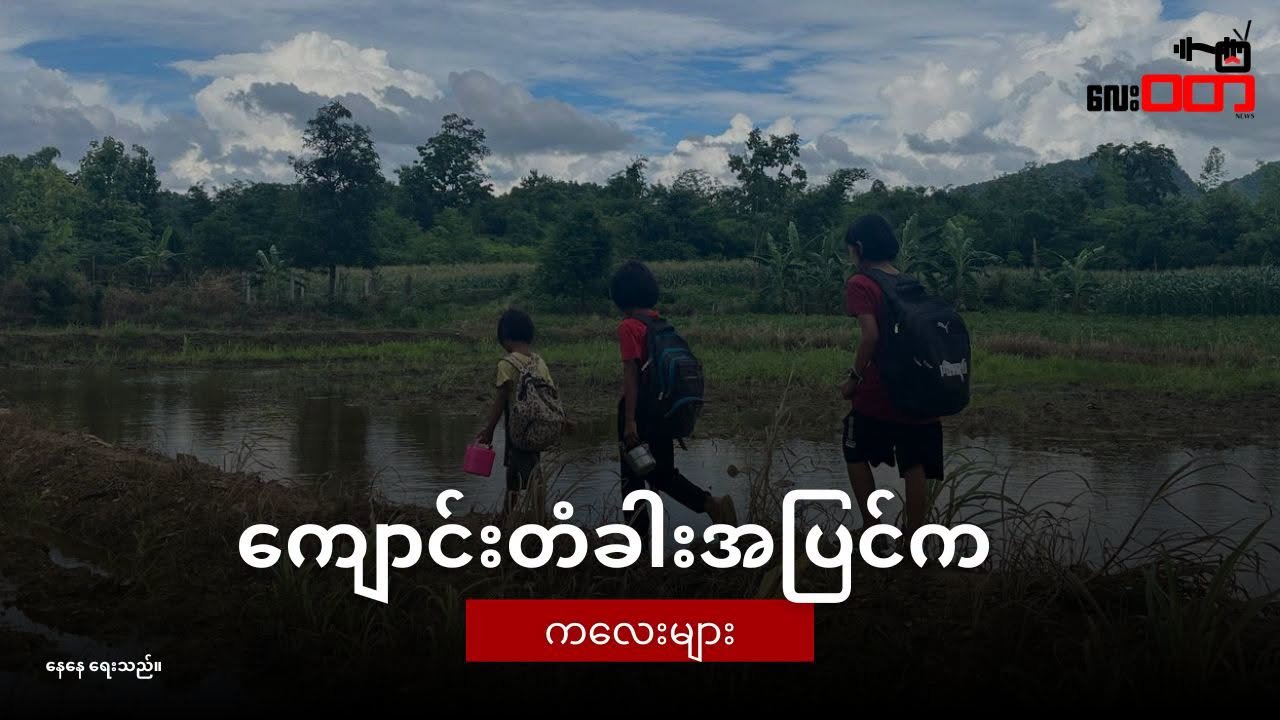
In the early monsoon season, along a green embankment path where wild grass and touch-me-not compete to sprout on either side of the paddy fields, twin brothers walk along, each carrying a shoulder bag.
Anyone who caught sight of them might easily have mistaken them for two schoolboys cutting across the paddy embankment on their way home from school.
But their bags held no books. Inside were only water grass leaves, roselle leaves, bamboo shoots, and other wild vegetables gathered from the forest. They were not returning from school—they were coming home after helping their father at his charcoal kiln.
Covered in mud, the two brothers dumped the vegetables from their shoulder bags onto the shallow bamboo tray. “We were busy tending the charcoal fire, so we didn’t get a chance to look for anything for the curry,” the younger boy aged 12 called out to his older sister.
Beside him, his twin brother was likewise emptying vegetables from his own bag. The matching shoulder bags that, until last year, had carried schoolbooks, have now become bags for carrying wild vegetables gathered from the forest.

“The two younger ones stopped going to school and helped their father make charcoal . The oldest one raises pigs and cooks at home. None of the three go to school anymore. The youngest boy is still in kindergarten, so we can still manage to keep him in school—but we can’t afford to keep the older ones in anymore,” said their mother, Ma Tin Tin Win.
Until last year, the twin brothers and their eldest sister had been students at a basic education high school in a village in Thandwe Township, Rakhine region.
During and after the fighting, the family of six—including Ko Ko and Nyi Nyi—has been struggling desperately just to keep from going hungry. In addition, repeated bombing attacks on schools and hospitals have made it impossible for them to attend school regularly, leaving them reliant only on makeshift, temporary learning circles.
But even as the military situation has gradually stabilized, many children still have not been able to return to education. The reason is no longer security alone, but the cost of teachers’ salaries and school expenses.
“Because parents have to keep paying teachers’ salaries, more and more of them can no longer afford to keep their middle-school and high-school-aged children in school. For parents who are already struggling just to put food on the table every month, paying these fees on top of that is simply beyond their means,” said Daw Kyi Myint, a parent from Thandwe.
Currently, it is reported that parents are being asked to pay roughly 10,000 kyats a month per primary school student, 20,000 kyats per middle school student, and 30,000 kyats per high school student to cover teachers’ salaries.

Rising costs of school textbooks combined with the burden of contributing to teachers’ salaries have become a heavy load for families with few job opportunities and low incomes. This has emerged as one of the main factors pushing middle- and high-school-aged children in Rakhine region out of the education system altogether.
According to a publication released by the Institute for Strategy and Policy–Myanmar (ISP-Myanmar) on 23rd June, as the 2026–2027 academic year begins, more than 6.3 million children remain out of basic education for various reasons.
Moreover, the report also noted that while more than 900,000 students sat for the university matriculation exam in 2020, that number had fallen to only around 250,000 by 2026.
These figures stand as evidence of the growing numbers of teenage students who have dropped out of school.
“As the new school year approaches, we have to negotiate repeatedly with parents just to get children back into school. Parents keep telling us they can’t afford the teachers’ salary fees. Among the teachers themselves, if one agrees to reduce their fee, another objects. This year there have been quite a lot of children whose parents have made the decision not to re-enroll them simply because they can’t pay. Every time the school year starts, it’s genuinely distressing for us,” said Daw Ei Ei, a middle school teacher.
For some students whose families cannot afford to pay teachers monthly during the school year, teachers themselves have had to take the lead in soliciting donations from domestic and overseas donors just to cover their own salaries, Ma Ei Ei said.
In early June, reports emerged that the Arakan administrative body would pay teachers’ salaries directly, but on the ground, schools report that parents are still the ones bearing the cost of teachers’ salaries.
“The news about salaries to be paid by the administration isn’t official yet. For now, it’s still the parents who are paying,” said a member of a ULA/AA-affiliated administrative body in Thandwe Township.
Education is a basic right of every child, and it should not be a right lost simply because of the salary burden placed on teachers.
The growing number of children like Ko Ko and Nyi Nyi—carrying wild vegetables in their school bags instead of books—is a troubling sign for the future of Arakan society as a whole.
For this reason, whether during conflict or in its aftermath, it is critically important that every child be able to return to school without financial barriers standing in their way.
School bags should not become bags for foraging in the forest, and teenagers should not be forced out of the education system.
For Ko Ko and Nyi Nyi, the school gate has not merely closed temporarily—it has been shut to them permanently because their family cannot afford the cost of education.
To prevent more teenagers like them from being pushed out of school, it is now more urgent than ever to establish a genuinely free basic education system that allows every child to learn without financial obstacles.
#Education #Arakan